

On Dreams: The Multidimensional Literacy Our Age Has Forgotten
On the imaginal realm, the soul's native language, and what the night has always known
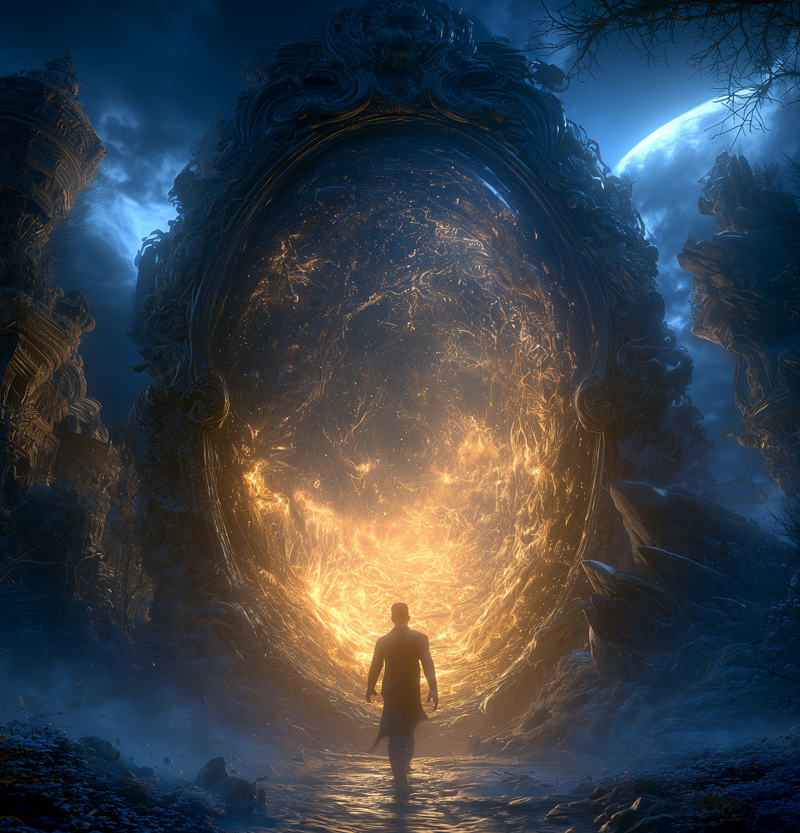
Every night, the truest part of you speaks. Not in the careful, edited language of waking life — not the version of yourself shaped by obligation, performance, or fear — but in the raw, unmediated tongue of the soul itself. You close your eyes and something deeper than thought takes over: a wanderer moving through a country without maps, where the dead speak with the voices of the living, where time doubles back on itself like a river meeting its own source, and where the ordinary logic of your waking hours yields to something older, stranger, and infinitely more precise.
Modernity tried to convince us otherwise. It called the dream neurological static, the brain’s housekeeping, noise without signal. To take it seriously was to embarrass yourself at the table of rational discourse. But the soul did not forget what the intellect dismissed — and neither did the civilizations that built themselves on what came in the night. The Assyrians kept professional dream interpreters alongside their generals. The ancient Egyptians practiced dream incubation — sleeping in a sacred temple to receive divine guidance — as a legitimate arm of medicine and statecraft. The Iroquois Confederacy regarded dreams as obligatory communications from the soul that the waking community was ethically bound to honor. The Greeks built temples called asklepieia, where the sick would sleep on consecrated ground and awake transformed. As Jung wrote, the dream is “a little hidden door in the innermost and most secret recesses of the soul” — and through that door, consciousness explores realms that waking awareness cannot yet contain.
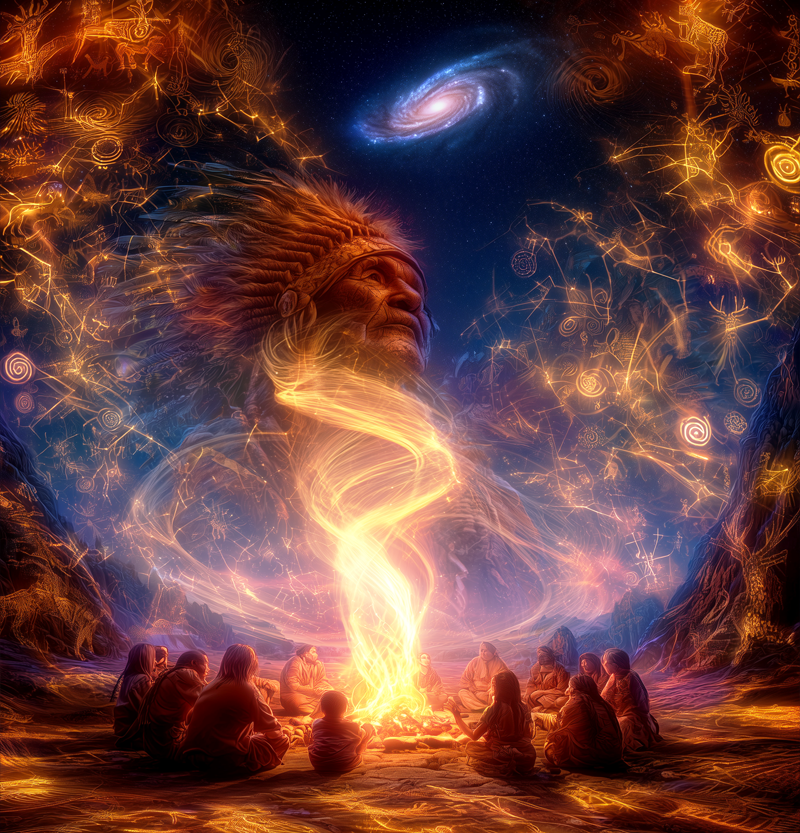
Long before human beings raised temples or codified law, they built meaning out of images — the ancestor arriving with a warning, the animal that spoke, the water that never dried. These were not primitive confusions between reality and hallucination. They were a sophisticated epistemology operating through resonance rather than deduction, through symbol rather than proposition.
The Aboriginal peoples of Australia call it the Dreamtime — Tjukurpa — but to translate this as “dream” in the way a contemporary Westerner understands dreaming is to immediately lose most of what it means. The Dreamtime is not a period of unconsciousness. It is the foundational stratum of reality itself: the creative ground in which the world was sung into being, underlying every moment of waking life. The Senoi people of Malaysia began each morning as a community of dreamers, sharing visions before practicalities intruded. Children were taught not to flee the monsters that appeared in dreams but to confront them, demand gifts of them, and report back at breakfast what they had received. The dream was curriculum. The night was school.
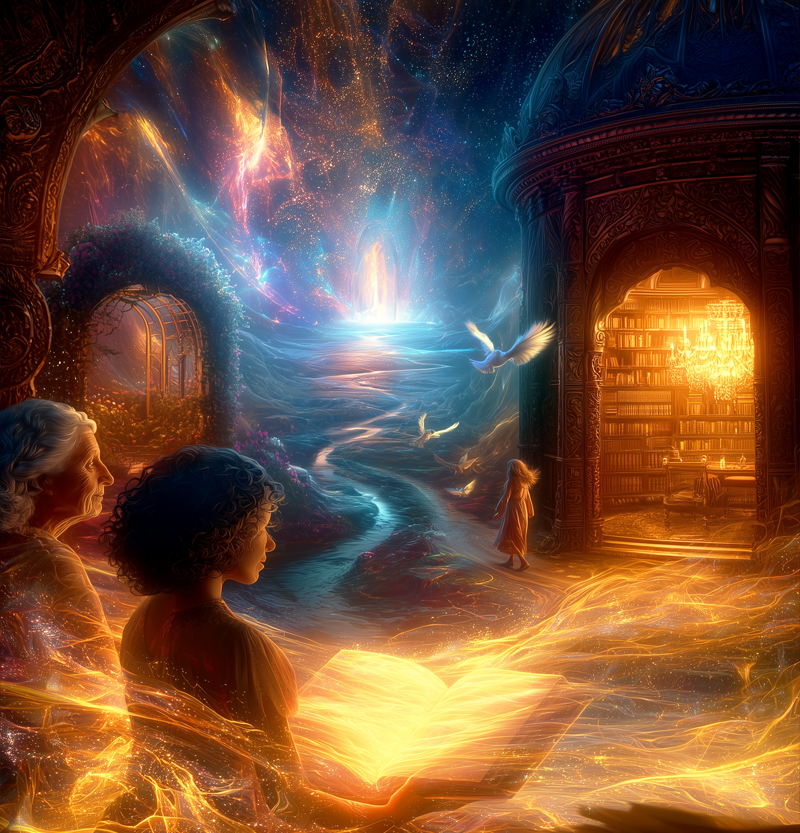
Henry Corbin, the twentieth century’s great scholar of Islamic mysticism, coined the term mundus imaginalis — the imaginal world — not as a synonym for fantasy, but as a designation for a distinct order of reality. Neither the physical world of matter nor the purely mental world of subjective imagination, the imaginal is, in Corbin’s formulation, an intermediate realm where spiritual realities take on form and bodily realities take on meaning. The Persian mystic Suhrawardi had mapped this territory centuries earlier, describing the ‘alam al-mithal — the world of similitudes — in which archetypes walked and the soul pursued its education across lifetimes. Ibn Arabi treated the dream world as the primary site of spiritual instruction, insisting that what occurs in dreaming is no less real than what occurs in waking; only the mode of perception has changed.
This is not mysticism in the dismissive sense. It is a phenomenologically precise claim: the images arising in dreams are not invented by the individual ego but drawn forth from a domain with its own laws and ethical demands. The dreamer who encounters a wise old woman, a dying king, a luminous stranger who hands over a key is not fabricating. She is making contact. She is, in the truest sense, awake — more awake, perhaps, than she is at noon. The encounter carries the weight of an event, not an invention.
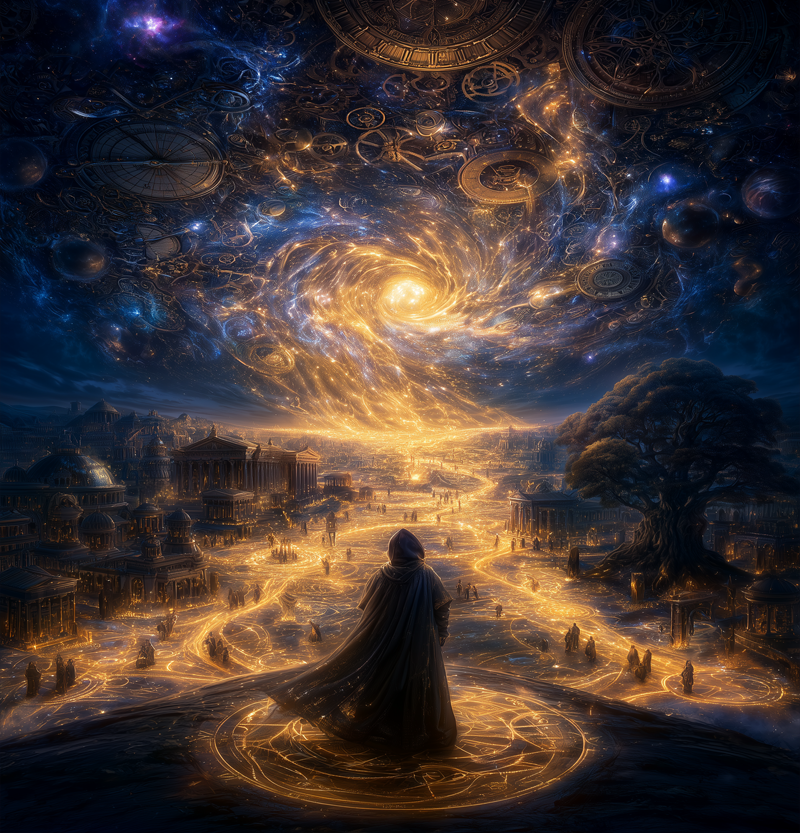
Physics, which spent the twentieth century dismantling the Newtonian clockwork universe, has arrived at a picture of reality that would have startled no shaman. At its most fundamental level, the universe is made of probability fields — superpositioned possibilities that collapse into determinate reality only under observation. Time itself, Einstein demonstrated, is not absolute. It bends. It is relative to the frame from which it is measured.
What happens, then, when we take seriously the long record of precognitive dreaming? J.W. Dunne, the British aeronautical engineer who catalogued his own prophetic dreams across decades in his 1927 work An Experiment with Time, proposed that consciousness occupies a position slightly outside ordinary temporal sequence — able, under certain conditions, to perceive along the time-axis in both directions. The physicist Wolfgang Pauli underwent a period of Jungian analysis in which the symbolic content of his dreams corresponded so precisely with frontier problems in quantum physics that the two men produced a joint monograph on synchronicity — the acausal connecting principle that neither psychology nor physics, alone, could explain. The dreaming mind does not experience time as a calendar. It experiences it as a landscape experiences light: simultaneously illuminated from multiple angles, without a fixed point of origin.
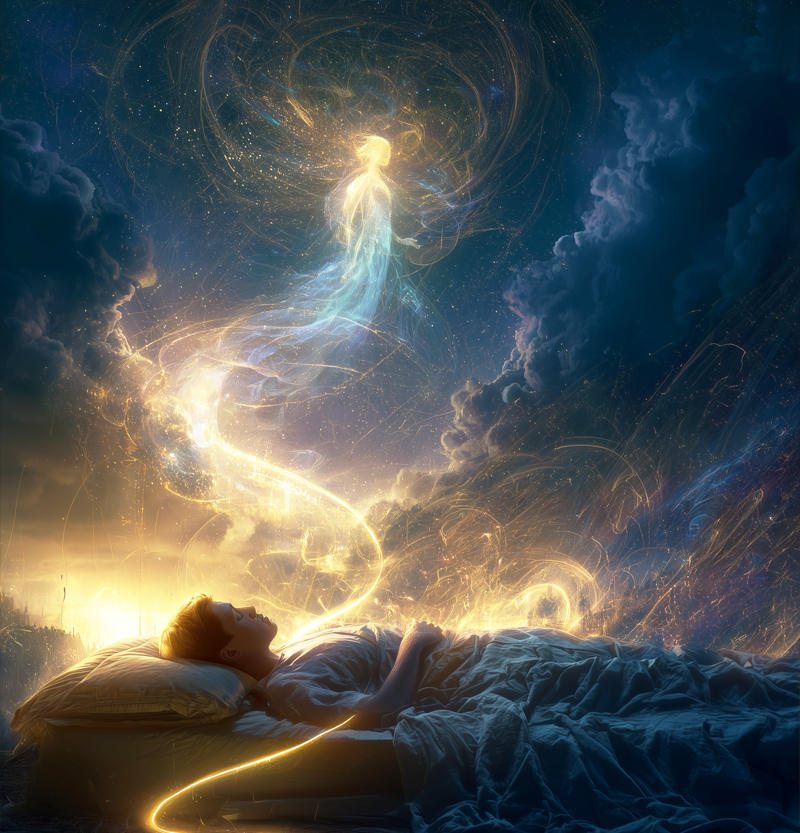
Dream intelligence is condensed, polyphonic. A single image can carry six simultaneous meanings the way a chord carries six simultaneous notes. What seems absurd from the outside — your dead grandmother in a kitchen that is also a church, handing you a book while wearing your childhood teacher’s face — is, when you sit with it, a communication of astonishing efficiency: emotional, biographical, mythological, and prospective information compressed into a single image. Jung distinguished the symbol from the sign: a sign points to a known thing, but a symbol is the best possible expression of something not yet fully known. A sign can be decoded. A symbol can only be lived into. James Hillman, who radicalized the Jungian tradition through archetypal psychology, distilled this into a single imperative: stick with the image. The image is not a code to be cracked. It is a face to be met.
In a civilization extraordinarily skilled at filling every silence with stimulation and every moment of interiority with managed noise, your dream life remains magnificently beyond reach. It cannot be harvested for data, surveilled, optimized, or subjected to algorithmic governance. It draws on a depth of the psyche beneath the reach of cultural programming, beneath ideology, beneath everything you have been told to think, feel, want, or fear. This is your sovereign ground. To cultivate a real relationship with the interior world that rises in you each night is to reclaim something no external authority can touch — a source of guidance and self-knowledge that belongs entirely, unconditionally, to you.
None of this arrives without practice. The dream gives generously, but it requires the willingness to receive. Record first — reach for a notebook in the dark, before the waking mind imposes its retroactive coherence. This act is not merely practical; it is an act of respect. It tells the dreaming psyche: what you bring matters. And the psyche, it turns out, responds to being listened to, growing more vivid and coherent over time as the channel between dreaming and waking clears. Then sit with what has come, resisting the reflex to domesticate the unfamiliar — to say “that must mean this” and dissolve the symbol into an explanation. The dream asks us to dwell in the presence of the image the way we dwell before a great painting: returning, allowing meaning to deepen across encounters rather than crystallize in a single reading. Finally, act. A dream received and meditated upon but never brought into contact with the choices of a life is a letter read but not replied to. At some point, the interior imperative presses outward. The artist whose dreams have been telling him for years that he has abandoned his true work must eventually sit down and paint.
Your dreaming mind has always known what linear consciousness is only beginning to discover: that reality is layered, that time is porous, that you extend far beyond the boundaries of your skin. These are not new-age assertions. They are recoveries of the oldest forms of human knowing, finding confirmation in theoretical physics, depth psychology, and the testimony of every contemplative tradition that has ever taken the night seriously. To become a conscious dreamer is to inhabit the full dimensionality of who you are — not merely the daylit, productive surface, but the vast luminous interior from which that surface perpetually arises. The mystics agree: the soul is already awake. Every dream is its voice reaching through. The dreamer who listens does not leave the world. She returns to it more fully herself — with deeper knowing, wider sight, and the unmistakable quality of one who has been, however briefly, all the way home.